
Previously
In a past article, we explored what academic literature tells us about tutorial design. Researchers have investigated how games introduce mechanics, support learning, and maintain player engagement during the crucial opening moments of an experience for decades. While this work has established a strong understanding of effective tutorial design, most approaches share a common assumption: that every player receives the same experience.
As games continue to incorporate more adaptive systems (with modern titles already able to adjust difficulty, accessibility settings, matchmaking, and other elements of player experience based on individual needs and behaviours), tutorials remain largely static; providing the same information, in the same order, regardless of who is playing.
This raises an interesting question: could tutorials be more effective by adapting the content to the player?
This formed the basis of a pilot study exploring the potential of personalised game tutorials. The study investigated whether a tutorial informed by player behaviour and individual traits could influence player experience compared to a traditional, non-personalised approach.
Two versions of the same real-time strategy tutorial were developed: one following a conventional structure, and another incorporating telemetry-driven personalisation. By combining player questionnaires, gameplay data, and analysis of player behaviour, the study explored both the practical feasibility of adaptive tutorials and whether personalisation could produce measurable improvements in player experience.
The results were mixed. While the tutorial design itself was generally successful, evidence of a clear advantage from personalisation was limited. However, the study highlighted both the challenges and opportunities of using player data to create more responsive learning experiences — suggesting that adaptive tutorials remain a promising area for future game development and research.
To understand the academic basis for this study, you may benefit from reading the posted literature review.
From Static Tutorials to Adaptive Experiences
If tutorials are traditionally designed as a single experience for every player, the natural next question is whether games can use information about the player to create something more responsive. This is where game analytics and personalisation come in.
Data mining has been used across industries for decades, but within games it developed into a more specific practice: game analytics. Rather than simply collecting information, game analytics focuses on using player behaviour and in-game telemetry to understand how people interact with a game (Drachen, El-Nasr and Canossa, 2013). Modern developers already use these approaches in areas such as matchmaking, difficulty balancing, retention systems, and predicting player behaviour (Wallner, 2019).
Personalisation builds upon this idea by adapting an experience to (hopefully) better suit the player. In games, this is often seen through systems such as dynamic difficulty adjustment, procedural content generation, or adaptive recommendations to play. The goal is not necessarily to create a completely different game for every player, but to identify meaningful differences between players and respond appropriately.
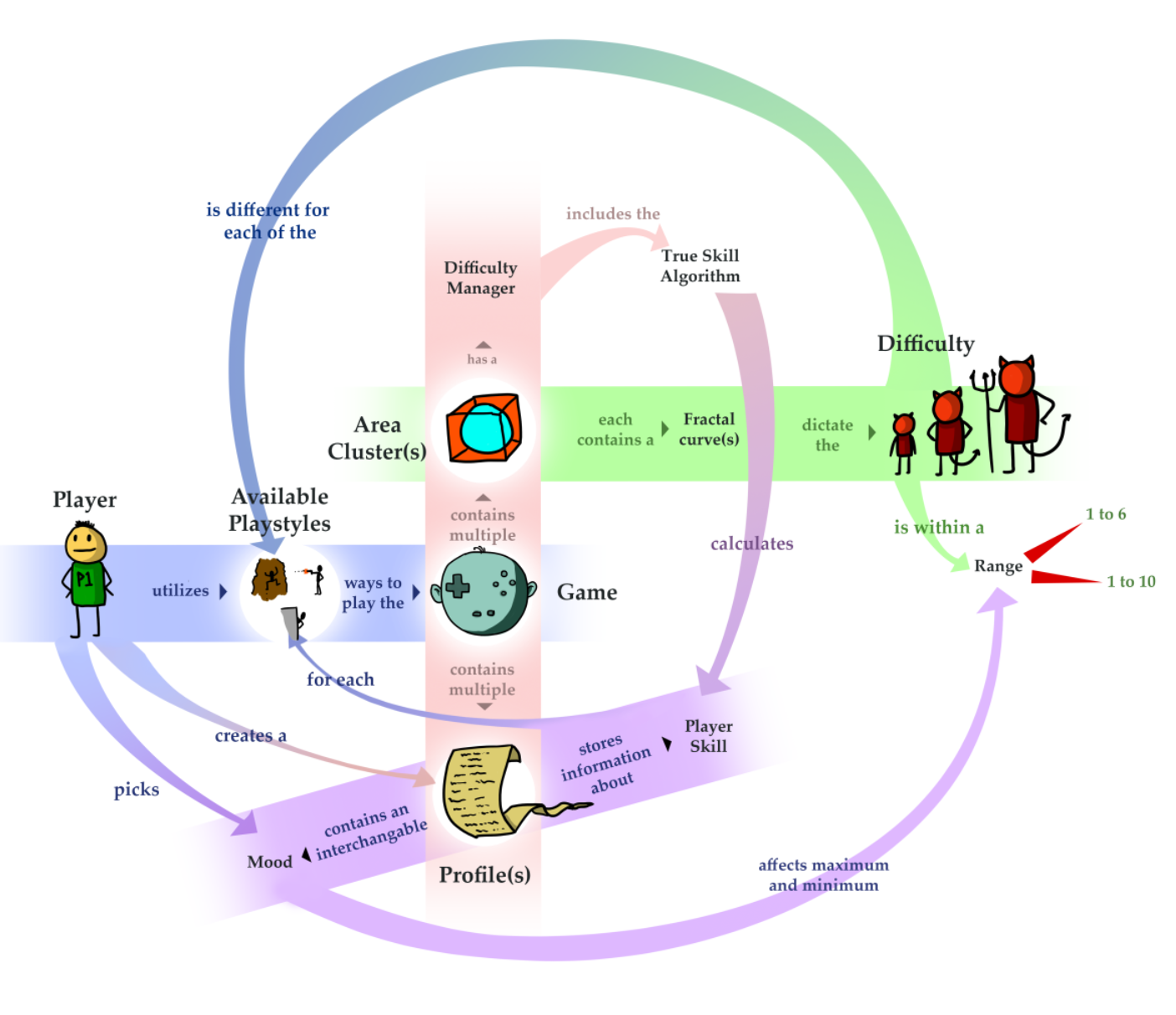
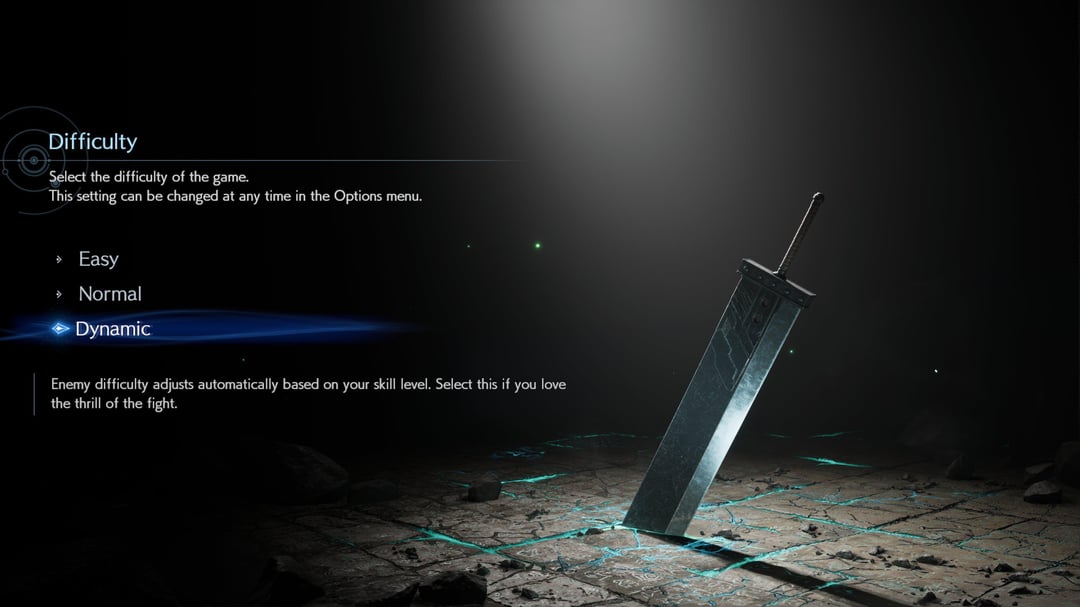
An obvious example is difficulty adjustment: a player struggling with a mechanic may receive additional support or have the difficulty adjusted dynamically, while an experienced player may benefit from less interruption. The most recent example I’ve played is Final Fantasy VII Rebirth (Square Enix, 2024), which offers a Dynamic difficulty mode that adjusts combat difficulty based on player performance.
However, effective personalisation requires understanding what makes players different - and this extends far beyond how difficult they want their battles to be based on how many times they’ve failed or succeeded previously. Player motivation is more complex - and preference models, such as BrainHex as explored by Rogers et al. (2016) have been used to categorise these types of individual differences. More recent work has proposed alternatives, including Tondello et al.’s (2019) Five Factor Player Traits Scale, which identifies player preferences across areas such as challenge, goals, narrative, social, and aesthetics.
While any of these could receive similar criticism to “Big Five”-style personality tests, they provide a useful, peer-reviewed starting point for understanding differences in player preferences. When combined with game analytics, these approaches create an interesting possibility: rather than simply observing what a player has done, a game could begin to predict what type of experience that player may prefer.
This idea formed the basis for this study: combining player profiling, gameplay telemetry, and adaptive design principles to explore whether a tutorial could respond differently depending on who was playing it.
Designing the Experiment
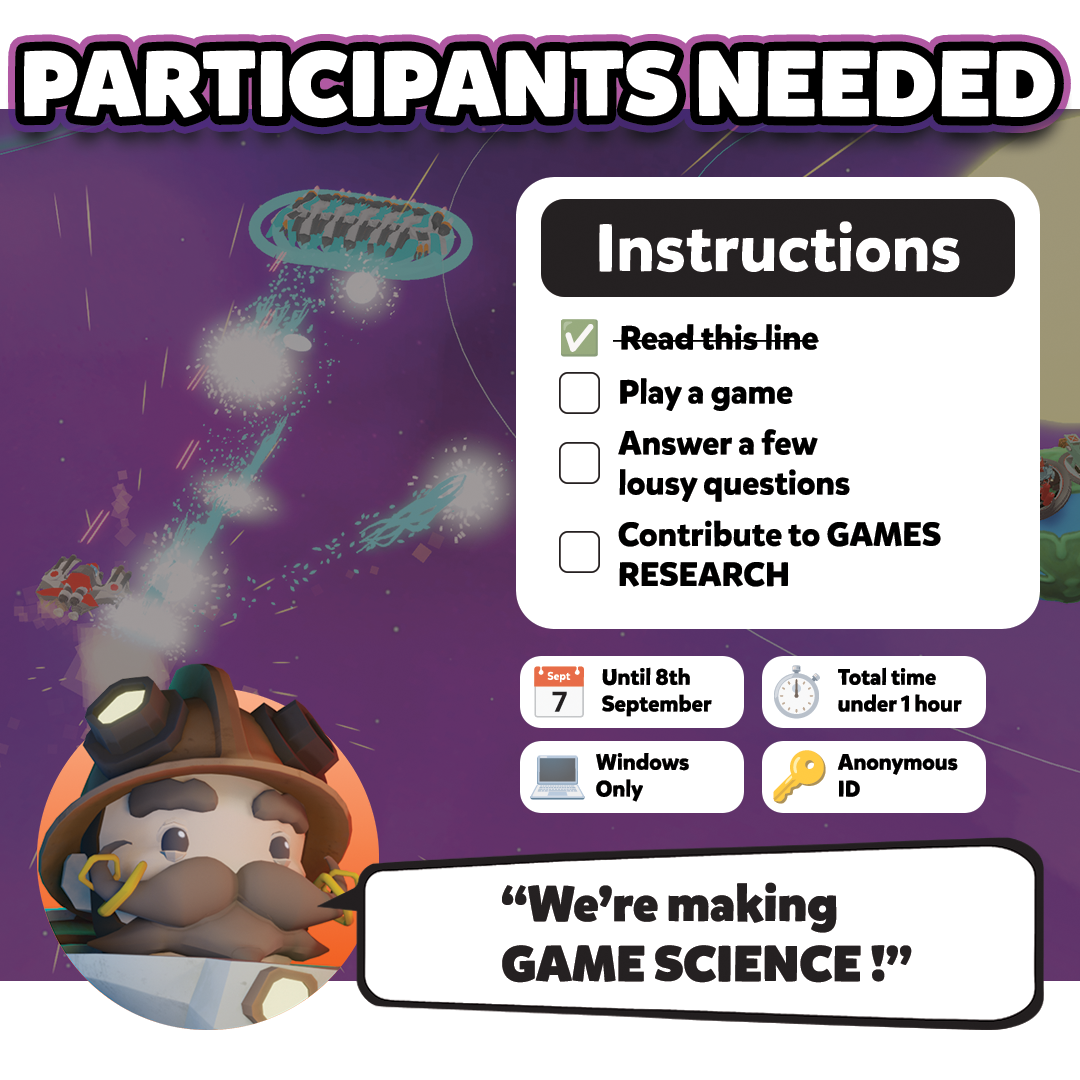
To test whether a personalised tutorial could improve the player experience, the study compared two versions of the same tutorial (similar to other papers found in the aforementioned literature review). In academese: it was designed as a quasi-experimental post-test control-group design with baseline player-trait assessment:
- Participants were randomly assigned to one of two groups. The first experienced a traditional, non-personalised tutorial, where every player received the same sequence of instruction. The second experienced a personalised version, where the tutorial adjusted elements of its design based on the player’s predicted preferences and behaviour.
- Before playing, participants completed a player traits questionnaire based on Tondello et al.’s (2019) Five-Factor Player Traits Scale. This provided an initial profile of their likely motivations and preferences, creating the basis for the personalisation system.
- After completing the tutorial, participants completed an adapted version of the Game Experience Questionnaire (GEQ) (IJsselsteijn, de Kort and Poels, 2013), measuring aspects of their experience such as competence, immersion, flow, and tension. Additional questions explored whether players noticed any adaptation and how they felt about the tutorial experience overall.
Alongside these surveys, the game collected anonymous gameplay telemetry throughout. This provided a second perspective: not only could the study measure how players felt about the experience, but it could also examine whether the system was accurately identifying player behaviours and applying appropriate adaptations based on the real-time capture of data. This was recorded using a Unity NDJSON package, which wrote the telemetry as an individual newline-delimited JSON file on the participant’s computer for later analysis.
Data Collection and Ethics
The study collected three forms of data: pre-game player profiling, in-game telemetry, and post-game experience questionnaires.
All participants provided informed consent before taking part, and all gameplay data was anonymised through the use of participant identifiers. The telemetry collected by the game focused only on gameplay behaviour, such as actions, timings, and interactions within the tutorial, rather than any personally identifiable information.
The collected data was used solely to evaluate the effectiveness of the personalised tutorial system. As with any study involving player data, careful consideration was given to privacy and ethical use, particularly as game analytics systems become increasingly capable of observing and predicting player behaviour.
Building the Test Bed: Terratorial
The test environment for this study was Terratorial, a real-time strategy game currently in development by Arrogant Pixel. The project provided a useful test bed due to its combination of accessibility, mechanical depth, and development flexibility. RTS games traditionally carry a high barrier to entry, requiring players to understand multiple interacting systems, making them particularly suitable for exploring how different players learn.
As a member of the development team, direct access to the game’s systems allowed the personalised tutorial to be integrated into the experience rather than added as an external experiment. This allowed the study to explore how adaptive systems could function within a real development environment.
The tutorial was designed specifically for the study rather than adapting an existing level. The tutorial level introduced optional objectives and moments of player choice to provide adequate opportunity to generate player data over time before presenting the intervention. The development of these new systems created natural opportunities to observe different behaviours: exploration, completionism, experimentation, and engagement with narrative or environmental details, while also allowing me to add in new game features which I had been meaning to get around to at some point.
The tutorial was structured across three acts:
| Stage | Purpose |
|---|---|
| Act 1: Controls | The first act introduced fundamental interactions: selecting units, moving them, and completing basic actions. This stage provided every player with a consistent foundation while allowing the system to begin observing their behaviour. |
| Act 2: Freedom | The second act introduced a more open environment. Players received a broad objective but were free to explore optional objectives and interactions. This was designed to reveal differences in player behaviour: would they pursue every available objective, experiment with systems, or focus only on the required task? |
| Act 3: Escape | The final act acted as both the narrative conclusion and the point where personalisation was introduced. In the standard version, all players experienced the same escape sequence. In the personalised version, the sequence was adapted based on the player’s predicted trait profile. |
Building a Player Model Through Telemetry
Rather than relying solely on questionnaires or self-reporting, this study explored a player modelling approach based on gameplay behaviour.
A custom telemetry system was developed to observe player behaviour across all three stages of the experience. The system collected only abstracted gameplay interactions, such as movement patterns, input behaviour, objective completion, camera usage, and interactions with objects within the game world. No personal information was stored within the gameplay data, and participants retained control over whether their telemetry data was submitted for analysis.
The system was designed around three connected stages:
| Stage | Purpose |
|---|---|
| Data Collection | Captures player actions and gameplay behaviours during the tutorial. |
| Player Modelling | Analyses behaviour patterns and converts them into measurable player tags. |
| Intervention | Uses the resulting profile to select an appropriate personalised experience. |
Rather than attempting to identify a player’s personality directly, the system created a simplified behavioural profile. Individual actions were converted into behavioural indicators, or tags, which could contribute evidence towards a particular player preference.
For example, a player who frequently explored the environment, moved the camera without issuing commands, or who used the zoom function to examine the 3D ship or space assets would contribute evidence towards an Aesthetic preference. Similarly, rapid objective completion, high input frequency, or repeated engagement with optional challenges could suggest stronger Challenge or Goal preferences. Inversely, skipping dialogue without reading would infer a negative score towards the Narrative preference.
To account for this, behaviours were tracked over time, with repeated patterns contributing more strongly than isolated events. For example, the High APM tag could theoretically be triggered by a cat walking across the keyboard, whereas Persistent High APM would only be created once the behaviour had appeared consistently across multiple time boxes. This allowed the system to distinguish between temporary actions and sustained behaviours.
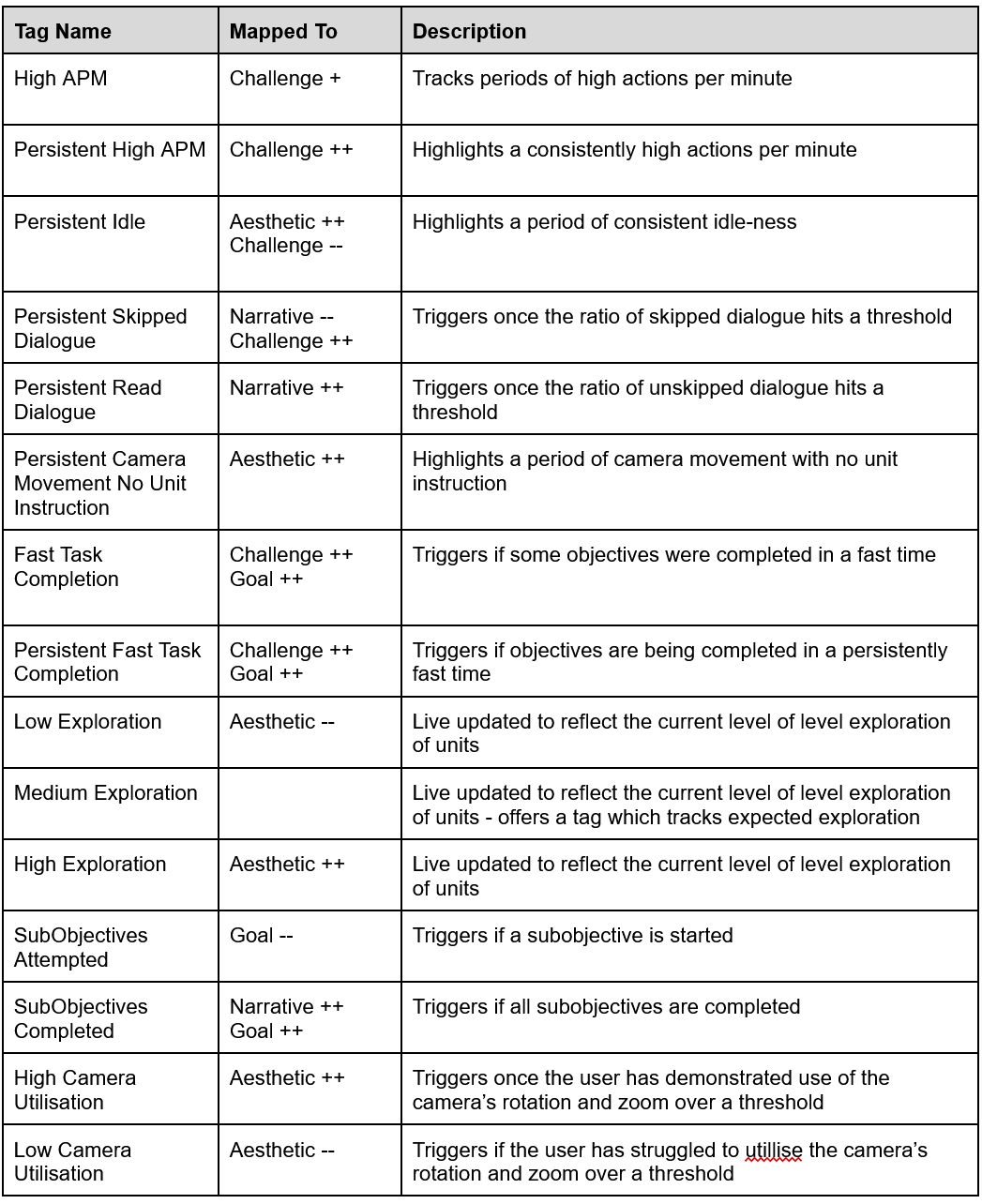
Once sufficient gameplay data had been collected, these behavioural tags were combined to produce an estimated dominant player trait. This process continued throughout gameplay, allowing the prediction to be refined towards the intervention point, where the gameplay would change based on the final classification.
The system was designed using modular components, allowing additional behavioural measures or classification approaches to be introduced in future iterations. While this study focused on a small number of player traits within a controlled tutorial environment, the architecture provides a foundation for exploring more sophisticated adaptive systems.
Although the system shares some goals with modern AI-driven personalisation, the intervention used within this study was intentionally lightweight. Rather than training a predictive machine learning model, it used a heuristic approach where observable behaviours contributed towards predefined player profiles. This provided a practical method for investigating the potential of personalised tutorial design while maintaining transparency over how player decisions influenced the resulting experience.
From Player Behaviour to Personalised Experience
The final stage of the system converts observed gameplay patterns into a simplified player profile, which is then used to select an appropriate tutorial intervention.
The Trait Classifier operates by combining the behavioural tags collected during gameplay. Each tag contributes evidence towards one or more player preferences, with stronger or repeated behaviours having greater influence on the final result. The system then produces an estimated profile, identifying the player’s most likely dominant preference alongside a confidence value used for analysis and debugging.
It is important to note that this process does not attempt to understand the player in a psychological sense, nor does it claim to identify a player’s personality. Instead, it creates a practical approximation based on observable behaviour: a player who repeatedly explores, seeks optional content, or spends time observing the environment may be more likely to appreciate an aesthetic-focused experience, while a player who pursues difficult objectives quickly may respond better to a challenge-focused intervention.
Once the player reaches the final stage of the tutorial, the Intervention Manager uses this estimated preference to activate an alternative version of the experience. Rather than presenting personalisation as an obvious menu choice or external system, the changes are integrated into the existing narrative flow through a code trigger embedded within a Timeline event. This allows the tutorial to adapt instantly without unnecessarily disrupting immersion.
Four interventions were created for the study, each designed around a different player preference:
| Preference | Intervention |
|---|---|
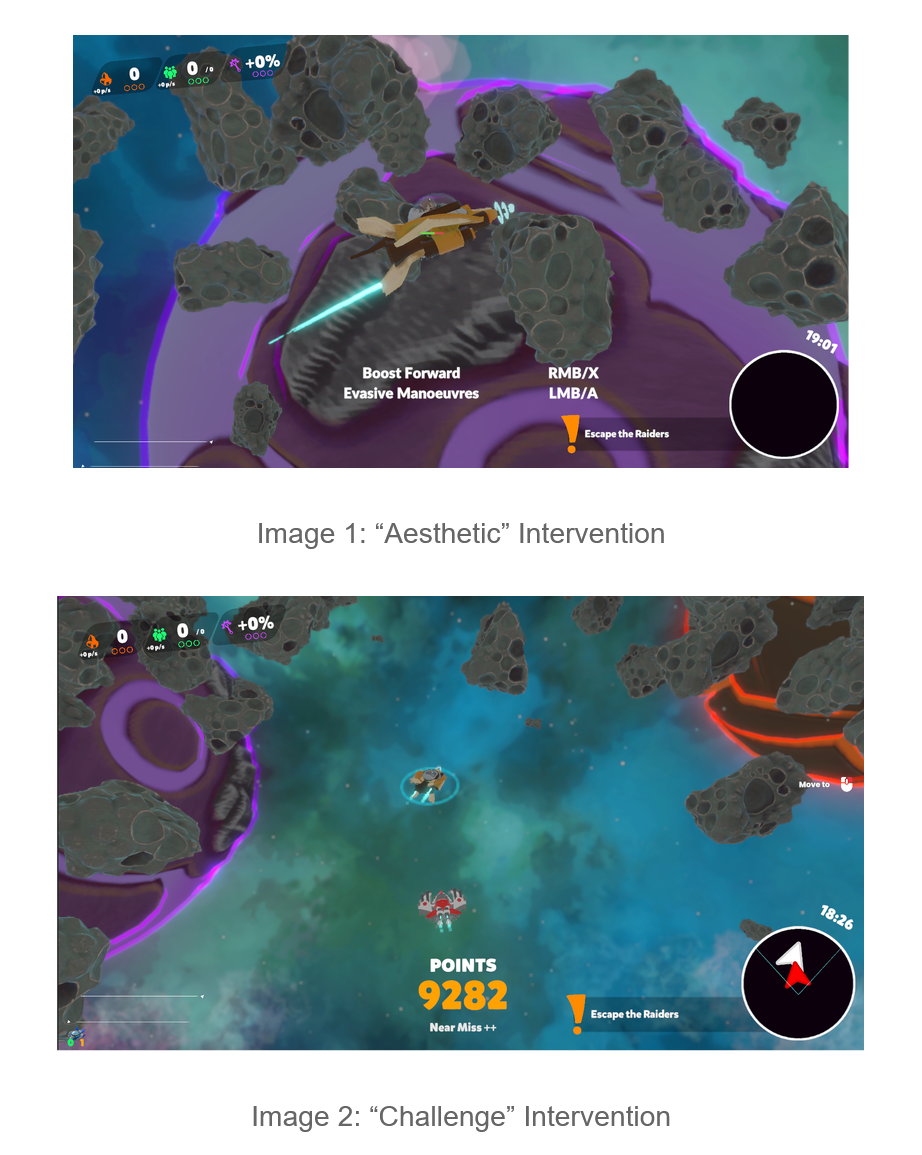
| Aesthetic | The tutorial shifts towards a cinematic experience, changing the camera perspective and simplifying controls to emphasise visual presentation and environmental appreciation. |
| Challenge | The player is introduced to a score-based challenge sequence, rewarding advanced behaviours such as avoiding damage, exploring the environment, and completing risky manoeuvres. |
| Goal | The player receives an additional optional objective, encouraging completion-focused behaviour through a clearly defined secondary challenge. |
| Narrative | The player encounters an interactive dialogue sequence with branching choices, allowing exploration of character relationships and additional story content. |
These interventions were intentionally designed as lightweight adaptations rather than entirely separate experiences. The aim was not to create four different tutorials, but to explore whether subtle changes in presentation, objectives, and interaction could improve alignment between the tutorial and the player’s preferred style of engagement. This approach reflects one of the central challenges of personalised game design: adaptation must provide meaningful differences while still preserving the identity and structure of the original experience.
Who Took Part?
A total of 23 participants volunteered to take part in the study. Of these, 17 completed the full study process and provided usable questionnaire data, resulting in a final sample split between the personalised tutorial group (n = 9) and non-personalised control group (n = 8).
The participants represented a particularly relevant but potentially biased group: individuals recruited primarily through games-related university courses and gaming communities. As expected, participants reported significant gaming experience, with the majority having more than ten years of previous gaming experience and almost all considering themselves above novice level.
Participants were familiar with common game conventions, reducing the possibility that the results were influenced primarily by unfamiliarity with interactive systems. However, it also introduced a limitation: experienced players may approach tutorials differently from less experienced audiences, potentially ignoring guidance they consider unnecessary or adapting more quickly to unfamiliar mechanics.
Interestingly, while participants were generally experienced gamers, familiarity with the real-time strategy genre was more varied. This created a useful balance for the study: participants understood games broadly, but many were still approaching the specific genre conventions that the tutorial was designed to introduce.
Establishing Player Preferences
Before playing, participants completed Tondello et al.’s (2019) Five-Factor Player Traits Scale to establish their initial motivational preferences.
Across the sample, Aesthetic and Narrative preferences scored highest overall, while Social was the lowest scoring trait. This distribution aligned with the design of the study, as the tutorial focused on four primary interventions: Aesthetic, Challenge, Goal, and Narrative. The social trait was excluded due to the single-player nature of the experience.
When identifying each participant’s strongest trait, the sample was relatively balanced across the three most common classifications:
| Primary Trait Result | Established Primary Trait | Dual/Shared Traits |
|---|---|---|
| Aesthetic | 4 | 0 Shared |
| Narrative | 4 | + 2 Shared With Other Traits |
| Challenge | 4 | + 3 Shared With Other Traits |
| Goal | 0 | + 2 Shared With Other Traits |
| Social | 0 | + 1 Shared With Other Traits |
Several participants displayed shared preferences, where two traits received equal scores. This highlights the limitation of treating player preferences as neatly separated categories.
The lack of strongly-classified Goal-focused participants was particularly relevant when interpreting later results. Although the Goal intervention was implemented within the tutorial, the system had fewer opportunities to test its effectiveness compared to the Aesthetic, Narrative, and Challenge interventions.
Results and the GEQ: Did personalisation improve player experience?
Participants completed an adapted version of the Game Experience Questionnaire (GEQ), measuring six areas of player experience: competence, immersion, flow, tension, challenge, and positive affect.
Overall, the results between the personalised and non-personalised groups were remarkably similar:
| GEQ Variable | Non-Personalised M (SD) | Personalised M (SD) | Mean Difference | Total M (SD) |
|---|---|---|---|---|
| Competence | 3.22 (1.10) | 2.93 (1.12) | -0.29 | 3.06 (1.11) |
| Immersion | 3.06 (0.95) | 2.88 (0.96) | -0.18 | 2.96 (0.96) |
| Flow | 3.00 (1.16) | 3.28 (1.09) | +0.28 | 3.15 (1.12) |
| Tension | 2.46 (1.32) | 2.57 (1.19) | +0.11 | 2.52 (1.24) |
| Challenge | 2.33 (1.05) | 2.67 (1.52) | +0.34 | 2.52 (1.33) |
| Positive Affect | 3.31 (0.97) | 3.35 (1.00) | +0.04 | 3.33 (0.98) |
| Statement | Non-Personalised M (SD) | Personalised M (SD) | Mean Difference | Total M (SD) |
|---|---|---|---|---|
| The tutorial adapted to skill | 2.75 (0.89) | 2.44 (1.24) | -0.31 | 2.59 (1.06) |
| The tutorial adapted to choices | 2.63 (1.06) | 2.78 (1.56) | +0.15 | 2.71 (1.31) |
| The tutorial delivered a tailored experience | 3.25 (1.16) | 2.89 (1.36) | -0.36 | 3.06 (1.25) |
| The tutorial was easy to follow | 4.13 (0.83) | 3.78 (1.20) | -0.35 | 3.94 (1.03) |
| The tutorial made me feel more confident | 3.63 (1.30) | 4.00 (1.00) | +0.37 | 3.82 (1.13) |
| The tutorial helped me understand quickly | 3.63 (1.30) | 3.56 (1.24) | -0.07 | 3.59 (1.23) |
| The tutorial was well-integrated | 3.38 (1.06) | 3.56 (0.73) | +0.18 | 3.47 (0.87) |
| I would recommend the tutorial | 3.88 (1.23) | 4.00 (0.70) | +0.12 | 3.94 (0.90) |
The headline finding was disappointing: the personalised tutorial did not produce a dramatic improvement in player experience.
The differences were small compared with the variation between individual players. While the personalised version appeared to slightly increase feelings of challenge and flow, it did not produce a clear improvement across the wider experience.
However, one of the most interesting findings came from the questions that specifically asked players whether they felt the tutorial had adapted to them. Players who received the personalised version did not necessarily perceive the tutorial as more adaptive - in fact, the group scored slightly lower when asked whether the tutorial adapted to their skill level or delivered a tailored experience.
What did players actually think?
While the quantitative results showed limited differences between groups, the qualitative responses revealed three recurring themes about how players actually experienced the tutorial.
1. The tutorial worked, but friction still mattered
“I knew what I had to do, and how to do it. It served well as a tutorial.”
Participants generally understood the game’s fundamental mechanics. The bigger problems were smaller points of friction:
- selecting units
- understanding control notation
- controlling the camera
“I got genuinely confused for a second by ‘LMB/A’ … I didn’t quite make sense of it immediately.”
Confusion about button inputs, particularly the mixed PC and console notation (i.e. “LMB/A”), confused some users and may have affected confidence and mastery.
2. Experienced players wanted to move faster
The tutorial had a hard balancing act that didn’t work for everyone.
Experienced players sometimes found the early sections repetitive:
“By the time I’d picked up my 3rd or 4th rock with the workers I was pretty over it.”
“As someone who has played a few RTS games before this felt very easy to the point I would probably skip it.”
Less experienced players appreciated the repetition, while experienced players often found the early resource-collection tasks slow, repetitive, or “grindy”.
The original assumption was that experienced players would naturally push beyond the basic objectives, giving the telemetry system more interesting behaviour to analyse. Instead, many continued completing the introductory tasks despite this.
3. There was a low salient perception of adaptation, but the intervention point was often pointed to as a highlight
Most participants didn’t realise that their tutorial had been personalised, or if they had it was often misattributed.
“The satellite felt like it adapted to my playstyle of exploring.”
This user identified a moment much earlier in the level, a secondary objective, as a point of adaptivity.
However, comments found under other topics often highlighted the intervention as a key moment:
“The chase at the end was pretty fun. It was challenging enough to hold my attention”
“The ending race against the enemy ship was the most enjoyable for me as the movement controls made it a lot harder to time and control the ship going around the asteroid field but once i got the hang of it, i felt like i was good at the game.”
“Jumping over the asteroids from the side view, because this required the most skill and concentration. I didn’t expect that, it shows the game from another angle and also showcases the art style.”
Act 3 could have been popular due to the design philosophy going in - this stage would be different, no matter the trait it was designed for. This is a powerful reminder of the importance of dynamism in game design - something that I hope to continue exploring through further study on this very site.
A promising first step, but not the final answer
The results suggest that building an adaptive tutorial is achievable, but proving that adaptation improves player experience is considerably more complex.
The system successfully collected gameplay data, classified player behaviour, and delivered different tutorial experiences based on those classifications. However, the measurable benefits were limited, and the strongest insights came from understanding how players interpreted the experience rather than simply whether one version scored higher than another.
In many ways, this reflects the wider challenge of personalised design. Creating different experiences is relatively straightforward. Creating experiences that feel meaningfully better because they are personalised is much harder.
The next generation of tutorials may not simply teach players how to play — they may learn how players prefer to learn.
What happened under the hood? An issue.
After the study, the telemetry data was compared against each participant’s self-reported player traits. The system was capable of producing classifications that sometimes aligned with the questionnaire results, and the complete pipeline functioned as designed: gameplay behaviour was collected, converted into tags, classified, and used to trigger an intervention.
But something else became apparent.
The aesthetic intervention was triggered more frequently than expected.
At first glance, this could look like a successful identification of an aesthetic preference. However, looking more closely at the tags contributing to the classification suggested another explanation.
Camera movement and environmental exploration were both treated as evidence of aesthetic interest. These were sensible assumptions when designing the system, but the thresholds were generous enough that relatively ordinary tutorial behaviour could accumulate enough evidence to push a player towards the aesthetic classification. Ironically, this bias also increased the likelihood that the system would appear accurate, because the participant group itself was skewed towards Aesthetic preferences. Analysis of the telemetry manager confirmed this bias. The system produced an average “point distance” of 1 from each participant’s primary reported trait, meaning that its prediction was, on average, one ranking position away from the participant’s highest-scoring trait.

Conclusion - did the adaptive tutorial work?
The answer is complicated.
The tutorial itself was generally well received. Across both versions, participants reported positive experiences around understanding the game, confidence and immersion, suggesting that the baseline tutorial design was effective. This likely reflects the use of established tutorial principles identified in the literature review, including clear and narratively-led tasks, gradual increases in complexity, and multimedia and interactive feedback.
Some GEQ measures were slightly higher for the personalised group, particularly flow and challenge, while others were slightly lower. Tension and Positive Affect were almost identical between groups, suggesting that the interventions did not introduce a significant increase in negative experience. However, the differences were small, and the sample was too limited to draw strong conclusions.
The study therefore doesn’t demonstrate that trait-driven personalisation produces a better tutorial. What it does demonstrate is that a telemetry-driven system can collect player behaviour, approximate player traits, and use that information to deliver different experiences at runtime.
However, the approximation wasn’t perfect. The system showed a noticeable bias towards the Aesthetic trait, partly reflecting the high aesthetic scores within the participant group, but also suggesting that some of the telemetry tags and weightings favoured this outcome. The system was deterministic in its classification, but its predictions were not consistently accurate. Among participants with usable NDJSON telemetry files it achieved an average separation of around one point from the participant’s primary reported trait. This suggests that the system was capable of approximating player motivations, but was not always precise in identifying the correct primary trait.
This also highlighted a bigger problem with player modelling: behaviour doesn’t necessarily tell us why someone is behaving that way. A player moving the camera frequently might be interested in the game’s visual presentation, or they might simply be trying to understand the controls. A player completing every optional objective might be highly goal-oriented, or they might just want to finish everything available to them. The telemetry system can observe the behaviour, but not necessarily the intention behind it.
Players also seemed to have their own expectations about what personalisation should look like. Perceived adaptation was consistently low, with participants sometimes mistaking non-adaptive elements for adaptive ones. Several players suggested that the game might become easier after they failed, such as after their ship was destroyed in the asteroid sequence. That wasn’t actually part of the trait intervention, but it points towards an interesting alternative.
Perhaps players don’t necessarily expect a game to identify that they are Aesthetic or Narrative players. They instead expect the game to recognise what they are struggling with and respond to it - echoing the logic behind dynamic difficulty settings.
Ultimately, this was a pilot study with a small sample and clear limitations. The findings should therefore be considered indicative rather than statistically conclusive. However, the study demonstrated that the technical framework was achievable, provided useful insight into the limitations of real-time trait classification, and highlighted several opportunities for further research.
Future work could refine the existing telemetry model, explore alternative trait taxonomies, test interventions with players who strongly identify with particular traits, or investigate other forms of personalisation such as proficiency-based adaptation. It could also examine whether these approaches remain effective across different genres, platforms and longer gameplay experiences.
Anderson, C.G. et al. (2024) ‘Show or Tell? A Comparison of Direct Instruction Tutorial and Learn By Doing Increased Impasse Versions of Initial Levels of a Puzzle Game’, in Proceedings of the 19th International Conference on the Foundations of Digital Games. FDG 2024: Foundations of Digital Games, Worcester MA USA: ACM, pp. 1–9. Available at: https://doi.org/10.1145/3649921.3650021.
Drachen, A., El-Nasr, M.S. and Canossa, A. (2013) ‘Chapter 2: Game Analytics – The Basics’, in Game Analytics: Maximising the Value of Player Data. 1st edn. London: Springer.
IJsselsteijn, W.A., de Kort, Y.A.W. and Poels, K. (2013) ‘The Game Experience Questionnaire’, FUGA The fun of gaming: Measuring the human experience of media enjoyment [Preprint].
Malevitis, A. (2017) Targeted Dynamic Difficulty Adjuster. Available at: https://arothel.wordpress.com/2017/11/07/targeted-dynamic-difficulty-adjustment/
Rogers, K., Kamm, C. and Weber, M. (2016) ‘Towards Player-Centric Adaptivity: Interactions of Gameplay Behaviour and Player Traits in a Survival Game’, in Proceedings of the 2016 Annual Symposium on Computer-Human Interaction in Play Companion Extended Abstracts. CHI PLAY ’16: The annual symposium on Computer-Human Interaction in Play, Austin Texas USA: ACM, pp. 269–276. Available at: https://doi.org/10.1145/2968120.2987725.
Tondello, G.F., Arrambide, K., et al. (2019b) ‘“I Don’t Fit into a Single Type”: A Trait Model and Scale of Game Playing Preferences’, in Lecture Notes in Computer Science. Cham: Springer International Publishing, pp. 375–395. Available at: https://doi.org/10.1007/978-3-030-29384-0_23.
Wallner, G. (2019) Data Analytics Applications in Gaming and Entertainment. Florida: CRC Press. Available at: https://ereader.perlego.com/1/book/1501572/4.